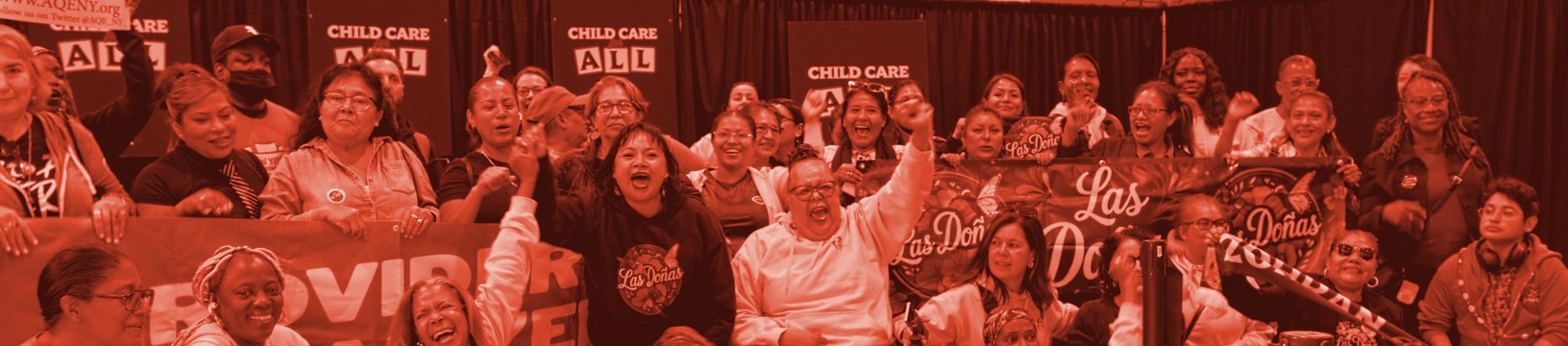
POP providers cheering at a rally under Child Care for All signs
PAY OUR PROVIDERS

Child care is the work that makes all work possible.

New York is building universal child care. But the providers who make it possible earn less than 96% of the state's workers, and New York City family child care providers take home a median of $6.01 an hour. Universal child care can't be built on poverty wages. It's time to Pay Our Providers.

The power we're building

Policy follows power. We're building it district by district.

Pay Our Providers is an organizing campaign built and led by providers, parents, and organizations committed to pay justice. There is no more pressing need in child care than for providers to be compensated justly, and we are pushing for the policies that will solve this crisis. Ultimately, it is only our power as an organized group that can win and sustain these policies. Join us.

How people move into the campaign

POP's provider unions, community organizations and parent and family groups bring people in as members, and the campaign moves them up: to showing up, to joining a committee, to leading.

  • Faith leaders
  • Business and employer networks
  • Pediatricians and health care
  • Organized labor
  • Child care advocates
  • Researchers and economists
  • Provider unions
  • Community organizations
  • Parent and family groups
  1. MembersActivating your organization's members with education and organizing.
  2. EngagedMembers are pledging to join the campaign and attending events and actions.
  3. CommitteesParticipation in campaign coordination committees
  4. LeadersDevelopment of campaigners and into leaders of local campaign work.

Where they're landing

POP campaign members are all over New York State, every where providers and parents are located, we're looking for organizers and members.

Map of New York State showing where campaign members are concentrated: most densely in New York City, with clusters in Buffalo, Rochester, Syracuse, the Capital Region, the Hudson Valley and Long Island Schoharie County Seneca County Orleans County Wayne County Greene County Allegany County Oswego County Nassau County Monroe County Herkimer County New York County St. Lawrence County Orange County Tompkins County Onondaga County Albany County Suffolk County Jefferson County Livingston County Wyoming County Schuyler County Tioga County Chemung County Westchester County Niagara County Oneida County Essex County Otsego County Hamilton County Montgomery County Franklin County Lewis County Broome County Schenectady County Steuben County Chenango County Sullivan County Putnam County Rockland County Columbia County Clinton County Kings County Cattaraugus County Chautauqua County Queens County Rensselaer County Richmond County Ulster County Bronx County Saratoga County Fulton County Dutchess County Cayuga County Erie County Cortland County Madison County Washington County Genesee County Warren County Delaware County Yates County Ontario County Staten IslandQueensBrooklynManhattanBronxNew York City Long IslandCapital RegionHudson ValleyWestern NYCentral NYFinger Lakes
Fewer to more members by countyMembers by zip code

Help us build our power. Get on the map.

Our demands for New York State's budget

Investing in Providers is Investing in Families.

$1.8B

A wage scale for child care workers

Guarantee thriving wages for all child care providers throughout New York State, whether in center or residential settings, without changing what families pay.

The details
  • Pay follows the scale built by the NYS Early Childhood Education Workforce Collaborative, led by CUNY's Professional Development Institute, based on role, experience, credentials and competencies.
  • It's grounded in parity with public school teachers in local public school systems because child care providers are educators. Credentials like a CDA, associate's, bachelor's, and others help providers advance -- but experience alone counts for pay increases too.
  • Family child care providers start 10% above the teacher scale, because they run a business as well as teach. Assistants start 10% below. Directors are benchmarked to assistant principal and principal pay.
  • Raises can't come out of parents' pockets: no tuition increases for private-pay families, and no interference with collective bargaining.
  • The $1.8B is the cost when fully phased in.

$1.2B

CCAP for every eligible family

Providers and families alike depend on the Child Care Assistance Program. It must be fully funded to end waitlists and ensure providers have fair, reliable income.

The details
  • $1.2B in new recurring funding, so no eligible family is turned away or waitlisted, and children with special needs can get the care they're entitled to.
  • In May 2026, 31 counties plus New York City had stopped enrolling eligible families because the money ran out. NYC's waitlist reached about 30,000 children before the City began moving 10,000 off it in October.
  • Running CCAP for the 57 counties outside NYC through the State, rather than county by county, so a family's chance at care doesn't depend on its zip code.
  • For providers, fully funded CCAP means classrooms at capacity and payments they can count on.
Providers and advocates around a table at the NYCAT convening
Providers, advocates and organizers at the New York State Child Care Alignment Table on September 28, 2026

Grounded in the policy principles refined by hundreds of providers and policy advocates:

On September 28, 2026, providers, parents, unions, advocates, researchers and elected officials met at the first New York State Child Care Alignment Table (NYCAT). Our 2027 demands are the first steps toward them.

  1. A statewide compensation standard and career ladder. A minimum compensation structure and career ladder for the entire child care workforce, with a wage scale like the CUNY PDI and New Mexico models, indexed to the cost of living.
  2. Subsidies and payment reform. Payment pathways, including pay subsidies and CCAP rates based on the true cost of care, so providers are paid on the wage scale without absorbing the cost themselves.
  3. Worker voice and bargaining. Providers in every setting, statewide, with the power to advance and enforce measures that secure pay justice, by leveraging tools like collective bargaining, wage floors, and more.
  4. Sustainable financing. A responsible phase-in of the wage scale, backed by a statewide progressive revenue package dedicated to it until child care is universal.

Go deeper

01The NeedPoverty wages, empty classrooms, families turned away
Providers from Las Doñas at the NYCAT convening

Providers are paid like their work doesn't matter

So the people leave, and the care goes with them

And families can't get in the door

  • Child care in New York averages $14,621 a year per child, the second-highest in the nation. Infant care in a center averages $20,459. NYS Comptroller, Feb 2025
  • In May 2026, 31 counties and New York City had stopped enrolling eligible families in child care assistance because funds ran out. The state budget added $1.2 billion for CCAP but nothing for workers' wages. New York Focus, June 2026
  • NYC's voucher waitlist reached about 30,000 children this fall. Thanks to organizing by POP and its allies, the City began moving 10,000 children off it in October. Thousands are still waiting. Chalkbeat, Oct 2026
02The SolutionA real wage scale, a funded CCAP, and the revenue to sustain them

A wage scale that treats early educators as educators

The scale, developed by the NYS Early Childhood Education Workforce Collaborative and CUNY-PDI, starts from a simple idea: caring for and teaching a two-year-old is as important as teaching a ten-year-old, in any setting. Here's what it would mean for real New Yorkers:

ProviderEarns nowWith the scale
Family child care educator in NYC, high school diploma, 21 years$33,280$79,184
Teacher in NYC, associate degree in ECE, 3 years$40,000$69,836
Family child care provider in Buffalo, high school diploma, 11 years$33,280$53,792
Center director in Rochester, bachelor's degree and administrator credential, 6 years$52,000$76,022

Source: NYS Early Childhood Education Workforce Collaborative / CUNY-PDI wage scale scenarios.

Full funding for child care assistance

$1.2B in new recurring funding, so no eligible family is waitlisted and providers can count on full classrooms and steady payments. A funded CCAP is how a wage scale reaches the providers who serve working families.

New York can afford it

Researchers including Lauren Melodia (Center for New York City Affairs) and the Day Care Council of New York also call for a sector-wide salary scale, a true cost-of-care standard in place of the market-rate survey, and a wage fund to bridge the gap.
03Our ChampionsElected officials across the State of New York who stand with providers
Elected officials standing at the head table during the NYCAT lightning round
Electeds stand for pay justice in the NYCAT lightning round, September 28, 2026.

At the New York State Child Care Alignment Table

These elected officials joined providers at NYCAT on September 28, 2026, for a dialogue on the pillars behind our demands. In a lightning round, they were asked to stand and stay standing for each of four pillars of pay justice they would support. These allies stood with us on all of them:

  • Sen. Jabari BrisportSenate District 26, Brooklyn · Chair, Children and Families
  • Asm. Andrew HevesiAssembly District 28, Queens · Chair, Children and Families
  • Asm. Catalina CruzAssembly District 39, Queens
  • Asm. Diana MorenoAssembly District 36, Queens
  • Council Member Jennifer GutiérrezCouncil District 34 · Chair, Subcommittee on Early Childhood Education
  • Asm. Anna KellesAssembly District 125, Tompkins/Cortland
  • Asm. Sarah ClarkAssembly District 136, Rochester

POP Child Care Champions in the City Council

Our five Child Care Champions on the New York City Council pledged to support POP's FY2027 budget priorities, advocate for them with their colleagues, stand publicly with providers, families and children, and make sure the City uses every available child care dollar.

  • Council Member Shanel Thomas-HenryCouncil District 21, Queens
  • Council Member Lincoln RestlerCouncil District 33, Brooklyn
  • Council Member Sandy NurseCouncil District 37, Brooklyn
  • Council Member Alexa AvilésCouncil District 38, Brooklyn
  • Council Member Shahana HanifCouncil District 39, Brooklyn

Are you an elected official ready to stand with providers? Get in touch.

04EndorsersThe organizations behind Pay Our Providers

Pay Our Providers is a campaign led by a powerful and diverse group of organizations, coalitions, and unions committed to fighting for the dignity and just compensation of New York State's early childhood education and child care professionals.

  • Providers Organized for Power
  • The Action Lab
  • Empire State Campaign for Child Care
  • UFT
  • CSEA / VOICE
  • Citizen Action of New York
  • New York Communities for Change
  • Alliance for Quality Education
  • ECE On The Move
  • Las Doñas
  • ILR Worker Institute
  • MomsRising

Add your organization. Provider associations, unions, parent groups, faith communities and businesses: stand with the people who care for New York's children.

Endorse the campaign

We're finishing what Shirley started.

Shirley Chisholm's first job was caring for children. In 1971 she championed a universal child care bill through Congress, only to see it vetoed. On December 2, her 102nd birthday week, we launch the campaign to finish the job.

Join the campaign

I commit to join the campaign to Pay Our Providers.